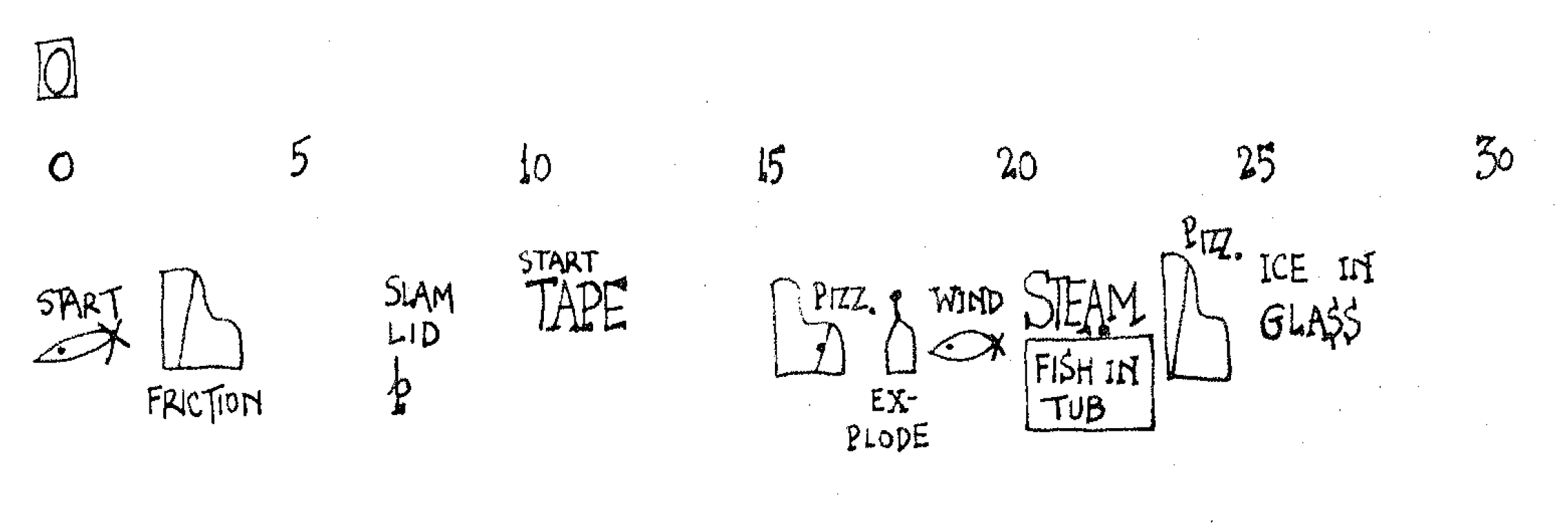
A section of Water Walk by John Cage. Image: Chrisfred3 – Own work, CC BY-SA 4.0, https://commons.wikimedia.org/w/index.php?curid=67958084
C-DaRE Invites introduces a new series titled The Body and Time, curated by Jonathan Burrows and Kerry Francksen.
Split-second decisions
On May 20th from 11-12:30 (BST), we will host Seke Chimutengwende, Rosemary Cisneros, and Lauren Scott, who will examine split-second decisions, focusing on what happens in the split-second before the next action in improvisation. Through their conversations, Seke, Rosa, and Lauren will explore the dancer’s awareness of the rapid play of conscious and unconscious impulses, the strategies that might emerge to navigate the overwhelming flow of possibilities, and how this split-second time alters our sense of consciousness and agency. Seke Chimutengwende shares perspectives from contemporary dance improvisation, Rosemary Cisneros brings her embodied practice of flamenco, and Lauren Scott speaks from her experience as a hip-hop dancer.
Reflective time
On May 26th from 11-12:30 (BST), Ramsay Burt, Kate Ledger, and Rosemary Lee will discuss reflective time, sharing perspectives on time in reflective and somatic performance practices, focusing on what Ramsay Burt calls the ‘experimental compositional approaches that threw the performer back on their own resources and thus awakened a sense of bodily experiences, and in relation to time.’ Kate Ledger is a pianist currently unpicking the legacy of composer Morton Feldman’s durational pieces; Ramsay Burt is a dance scholar who has written extensively on the radical dance of Judson Church in 1960s New York; and Rosemary Lee is a choreographer whose work often focuses on long-duration, site-specific performances with untrained dancers.
Comedic timing
For our next conversation, on June 3rd from 1:30 to 3:00 (BST), Pete Shenton, Tom Roden, and Sally Doughty will discuss the nature of comedic timing in dance performance. Together they will explore what makes an audience laugh or not, how approaches to time shape that response and why dance audiences often find quite unlikely things funny. Pete and Tom draw on their experiences collaborating as part of the acclaimed comedy stand-up duo New Art Club. Pete will also refer to his current PhD, which investigates this topic through a phenomenological lens. Sally Doughty brings her long-standing embodied practice as a dance artist and scholar, including recent collaborations with Pete that use comedy as part of their performance methodology.
Modes of attention
On 17th June from 11-12:30 (BST), we welcome Yves Citton and Bojana Cvejić to explore modes of attention, focusing on the impact of time on how, when, where, and why we focus our attention. Yves Citton is the author of ‘The Ecology of Attention’ (2017), and his most recent research looks at aspects of curiosity. Bojana Cvejić has been a dramaturge for choreographers such as Xavier Le Roy, Anne Teresa de Keersmaeker and Mette Ingvartsen, and her books include ‘Choreographing Problems’ (2015) and ‘Towards a Transindividual Self’ (with Vujanović, 2024).
Slow time
On 23rd June from 10:30-12 (BST), Tim Etchells and Adrian Heathfield round off the series with their discussion of slow time. Adrian and Tim are to discuss the nature and practice of durational performance. What forms, methodologies and performative strategies might emerge from an engagement with long duration, and how is our experience of time shifted by it? Adrian Heathfield draws upon his knowledge and research of live art performance, and particularly his long association with Taiwanese American artist Tehching Hsieh, whose series of year-long performances he helped curate as part of exhibitions at the Venice Biennale and the Dia Art Foundation, New York. Tim Etchells shares his long exploration of durational work with Forced Entertainment Theatre Company, including their 24-hour performances of ‘Quizoola’ (1996) and ‘Who Can Sing A Song to Unfrighten Me?’ (1999). which will close the series. Please sign up here: Slow time – Fill in form
You are warmly welcomed to join us.